Saturday, October 06, 2007

October Report: Shoreline Transformations

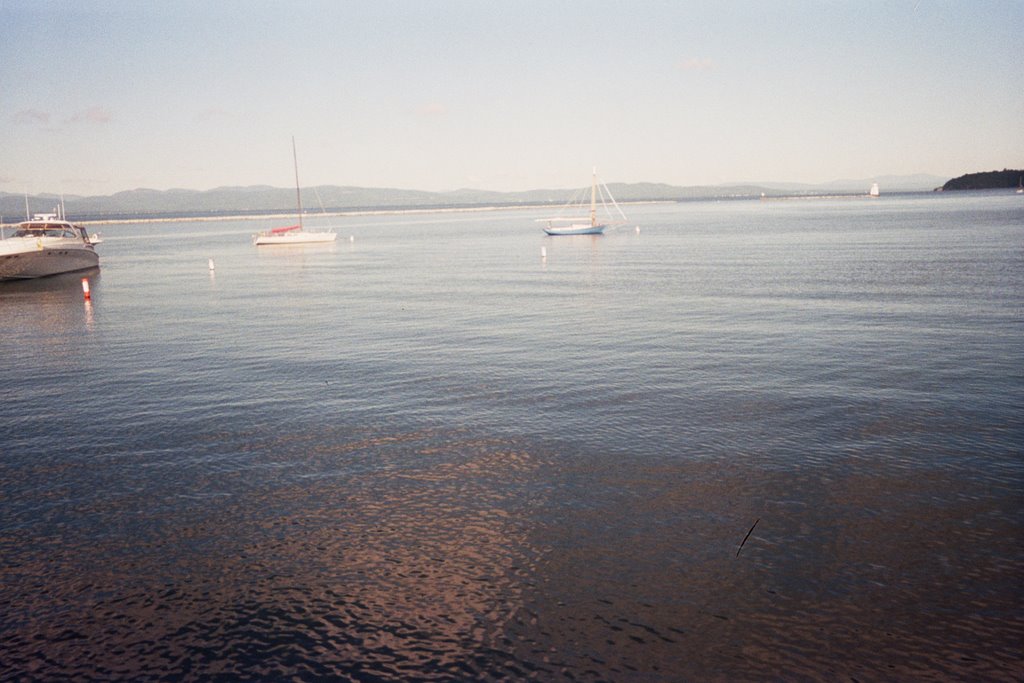
After having spent some time during the past couple of weeks mixing and mastering, I am pleased to announce that my new CD,
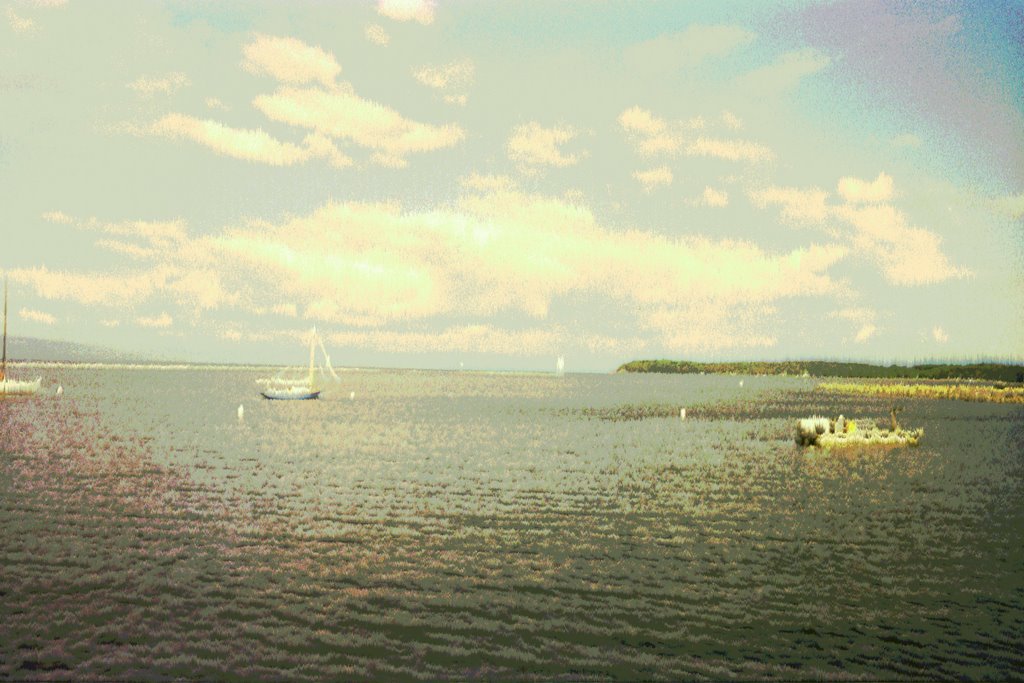
LIMINAL MUSIC 4: THREE SHORELINE TRANSFORMATIONS/THE FIRST LAST OUTPOST, is finished. I'll be releasing it in a limited edition, each copy with a hand-painted shorescape insert and an actual NOAA marine weather forecast print-out included.
The two long pieces are very slow-moving, with subtle, shifting spacial dimensions and a liminal harmonic and melodic haze - my attempt at conjuring in sound the deeper structures and fog-bound, tidal, breaking-wave mysteries of eternal shorelines.
If you would like to order a copy, please contact me at:
Bucky@rustyromance.com

You can listen to the music here:

http://buckyb.jukeboxalive.com/music_listen_1638551.html


As for the band, Rusty Romance, we are taking some time off from gigs this fall to spend time learning new songs that Rusty and I have written for the band, working towards a new 2008 album.
We'll be back on stage at First Night Montpelier, on New Year's Eve.

Wednesday, July 18, 2007

Back To Liminal


It’s been a busy summer with Rusty Romance-- a few road trips, Including a show at the Moxie Festival in Lisbon, Maine. But the band schedule is settling down for a while, so I’m at last finding time to catch up on this journal.
An earlier trip to Maine with the band-- staying in New Harbor, a beautiful, tiny Maine lobstering port-- filled me with inspiring images. I spent some downtime sketching the rocks, water, and boats. Now, back home in Vermont, I’ve been painting from those inspirations a few mornings a week. The other mornings I’ve been working away at my latest novel, about which I’m not ready to say much.
One exciting thing about painting is the way it has reinforced my ideas and approaches to musical composition. Back in May and June I created two long pieces that will likely make up my next CD, tentatively titled THE FIRST LAST OUTPOST. Both pieces begin with the same “drawing”: a performance on lap steel and looping device recorded in real time. But then each piece is worked into a “painting” with what I call transformations and sound-smears: like sonic brush-strokes; manipulations of light, shadow, texture.

As these works formed, I found myself returning to the ethos of my earlier concept of Liminal Music. To explain that concept a little better, here’s something I wrote in a 2005 retrospective:

Thoughts on Composition, Spring Equinox 2005

I’m sure that I share with many other composers the desire --the deep yearning-- to make sonic structures that I want to hear, that I want to exist in the world.
This imagining and this yearning most often lead me to the making of sound assemblages--evocations of place and landscape, inner and outer; narrative songs set within and woven with reference points of musical style and memory-- that while not always exactly, in the end, what I might have imagined them to be, turn out to be exactly what they need to be, even with all their mistakes and imperfections.
In the composing, improvisation, recording, and production processes--most often solitary--I have used the spacial considerations of effecting, panning, and mixing to leave an empty space for myself, and, by extension, for the listener.
In one sense, this is the ultimate creative self-centeredness: putting myself at the center of the sonic world. Of course, the inherent paradox is that this presence reveals itself as an absence: A silent space, in the midst of other spaces both silent and sounding.
When I began composing music that tended toward the-- for lack of a better word-- abstract, I realized that I was making works that, while stemming from the ambient tradition, did not work very well as background music. These were pieces that asked for focused attention, that needed the listener to share in the intended evocation of inner and outer landscapes, both experienced and conjured.
In looking for a name to describe these works, I came to see that the music was about places both real and imagined, about states of in-between: between sleeping and wakefulness; between land and water, between darkness and light at dusk or dawn. Thus the name: Liminal Music.

Sunday, April 15, 2007

Would You Like to Listen?

The link below will take you to a sampling of my music, including some pieces I've written about in this weblog.
I plan on updating the jukebox site every couple of months. The next time will probably be in early September.
Thanks for listening!

Friday, March 23, 2007

Spring Light


The onset of spring in northern New England brings changes in the light: the softening of hues; the lengthening of duration and shadow. This March the snow is still deep-- more than a foot in my backyard. But every day the snow-pack shrinks a little more, and even another big storm could only temporarily change the tide of spring's arrival.

In the past few weeks I've stayed with the themes and concerns of my composition THE INEFFABLE FREEDOM OF CAPTURED LIGHT. I've been painting on canvas in the mornings, answering a call that the exploration of changing light has offered. And I've spun off new musical pieces from various juxtapositions and confluences of the sonic elements of INEFFABLE FREEDOM, using them as sonic background to the act of painting. Over the weeks this work has cohered into a whole that I would like to someday present as an installation piece. (Right now the installation exists only in my studio.)

Given these concerns and interests it's perhaps no surprise that I'd be pulled into the sound world of a composer deeply influenced by the energies of visual art. As winter became spring, I found myself listening in the afternoons to a lot of Morton Feldman, including his six-hour-long STRING QUARTET NO. 2, which, I'll admit, I experienced as If I were reading a novel-- settling into it over the course of a few days, each time taking up where I'd left off before. There are sections of luminous and mystical beauty in this work; mysteries of tone and harmony that sometimes touched a longing in me and truly hurt my heart.

Also a musical companion some afternoons has been Susan Alcorn's remarkable AND I AWAIT (THE RESURRECTION OF THE PEDAL STEEL GUITAR). Susan Alcorn commits to and inhabits each note she plays; It's an all too rare quality in a musician, and for the listener, it can open up worlds. The long title piece offers surprises each time I hear it. And Susan's version of the Italian tune "Volare" is a pure joy: dreamy, alluringly textured, melodic; conjuring with an orchestra of multi -tracked pedal steel guitar something that suggests to me what Les Paul and Mary Ford might have come up with if they'd been hanging out with Sun Ra.

And now this morning the sky is blue. The snow has melted down an inch since yesterday. Time to go out for a run.

Monday, February 05, 2007

A Composition Journal, Part 4

January 21

AM
Made a few changes to "The Freedom of Captured Light" this morning. Returning to the
third-- and the first finished-- version, made some EQ changes to tame the hiss and rumble, making sure to keep the overall tonal coloration.
Next, I added complexity by doubling--then tripling-- the whole piece in separate tracks, panning and time-shifting (not by much) each track to create a sense of spaciousness and transparency.
And now this piece has come newly alive.

PM
Committing to a name: THE INEFFABLE FREEDOM OF CAPTURED LIGHT.

JANUARY 25

Morning reading : Cold Mountain Poet. A force of nature; humanity almost, but not quite, subsumed in rock, mountains, rivers, pines. (winds and waters.)
These poems, in David Hinton's deep and powerful translations (MOUNTAIN HOME: THE WILDERNESS POETRY OF ANCIENT CHINA) are having an effect on my musical composition. Or am I just riding a wave of synchronicity in my inner winter life right now?

Coffee, work on editing yesterday's two reviews for DUSTED. A quiet house for a while, so I took advantage and vacuumed floors.

Settled into some late-morning work on CAPTURED LIGHT: recorded glass bowls , struck with sticks. The sound made me think of bare rock beneath my feet. I treated the recordings with rolled-off old-time radio EQ, made a few various cuts and copies , then placed them within the mix of the most recent , composite, version of the entire piece. The bowls have a close-up sound that reminds me of a footpath, and perhaps that up-close-ness adds some welcome human scale/perspective as it wanders, unfolds within the big-sky, wide- horizon of sound that is predominant in the composition.


JANUARY 28
Afternoon
Hot bath, a beer. Reading in Holbrook's 1939 biography of Ethan Allen. An entertaining and engaging read, written in a sly and energetic "Yankee" voice.
Later, watching the sky change, the light move, I listen again to "The Ineffable Freedom of Captured Light ." I hear now that perhaps there should be some steel guitar early in the piece--a glimpse of blue as distant allure-- sliding in with major 7th blossoming, entering, reverb-ed for sense of distance, on the left--far left..

Now the sky has gone from blue to striations of violet--then a last blush of rose captured in high windows of high towers at Vermont College. The evergreens are almost black: spruces straight and tall; white pines caught stilled in what looks like mid-motion-- splay, sway, wave...
Dusk falling. I slipped off for a short winter's day nap.

Rising. Up and at 'em. Started a white bean stew.
Some work tonight on "captured light..", adding steel entrances as early hints of blue.
Also some EQ, scooping out bass mud accrued by multi-tracking.

JANUARY 29
Up at 6:30. Sub-zero again. Listening to latest version of "light", I think it's as good as I can make it. That is, it is what it is.
This piece really does go well with watching sunrise or sunset play out against the winter sky. The composition is 20 minutes and 50 seconds long. Maybe I should offer the listener instructions to begin playing the piece 20:50 before sunrise or sunset, and to look out a window while he or she listens.

You can listen here:

http://buckyb.jukeboxalive.com/music_listen_1638143.html

Thursday, February 01, 2007

A Composition Journal, Part 3

January 14 - afternoon

All this microscopic listening makes me edgy, grumpy. So, out for an hour's run in the snow.
My reward: Gray-green river, high and fast-moving under gray, snowing sky. The calm, monastery-like beauty of pine woods at Redstone park: snow-covered wooden benches, the stream and falls full, as they've been all winter.

Clear-headed, grounded, aerated, I listen yet again. I hear a few places that need work. I add more white (metallophone shimmer, pitch-shifted, reverbed), a bit of distant blue (steel guitar again; cut, looped, reverbed). I hear also a need for some translucent haze in the white (bells).

But for now, I need another break. I tend to get obsessive, working, pushing on until I'm satisfied--and/or exhausted. I'm going to try to do this piece a little differently.

January 15

Morning; a few more brushstrokes added. Listened on walkperson while I shoveled wet snow. Listened again while I walked to work. Almost done.


January 17

Crystal clear and cold-- sub-zero -- this morning. Some work on "Captured Light." An attempt at fine-tuning, but not quite getting it. Our heating system being fixed today, so it's COLD in the house. Bright sun, dazzling white snow-- shadows of tree branches on shiny surface crust.
I abandon music for the day, go out for a run. Back at home, I make a slow- simmering tomato sauce with peppers and hot Italian sausage-- an attempt to warm the house. Successful.


PM- Another attempt at EQ tweaking: cutting highs, boosting lower mids. Much better results: the piece has a thickness and warmth it didn't have before.

January 20

Listened to and compared, while editing some writing projects, both versions--original and re-EQd-- today. The first sounded better: more spacious and and airy; more shimmer.
I think the second version was satisfying at first from a sense of safety: it made the piece sound more like my previous work-- dark, murky, almost black and white.
But today I can trust the NEW direction behind the making of this piece. It seems the first mix is the one to go with.
(That said, there is still a need for some hiss reduction, maybe a slight taming of lows...)

Monday, January 29, 2007

A Composition Journal, Part 2

January 12. 2007

Woke up late after 9 hours (!!) of sleep. Gray morning. Coffee, read a few poems by Tu Fu.... Read them again.
To work on "Captured Light." My mission today is to paint in sound the color field I see as Gold/bright green. This entails taking a section of yesterday's work, cutting it, then re-harmonizing it in the program Acid. (I have tuned it 21 half-steps up.) Then cutting again to size and proportion, laying it in so that it fills the right time/space within the piece. I'm quite sure I've never worked so visually before; but it seems appropriate, given the inspiration for the piece. Like stepping back from a canvas, I listen. Make changes. Step back. listen again.


January 13

This morning's work: simply listening.
Gray, warm-ish but raw outside. Like April again.

January 14

Deep sleep. Up at 7. Snow falling; big, pretty flakes in gray dark morning.
Coffee, reading in Tu Fu. Sadness in these words; an autumnal chill of aging, regret.
Work on "Freedom of Captured Light." Recorded a shimmering pulse of metallophone for the color-field White-gold; after that, a steel guitar melody arcing to a Major 7th as its highest tone: A yearning, sweeping arc of bright blue (from mountain tops to sky.)
Next, hours of layering, moving, removing, mixing.
Snow falling.

Thursday, January 25, 2007

A Composition Journal, Part 1

For the past few weeks I've been working on a long composition, one that was, it seems, presaged by the arrival of the poem in my previous entry. For a while I'll devote this weblog to my journals about the creation of this work. I've never before kept a detailed daily journal of progress--from inspiration to implementation-- on a particular piece of music, so I'm finding this interesting.

January 9, 2007
Up at 6:30, reading the knife-sharp poems of Li Po-- David Hinton's remarkable translations in MOUNTAIN HOME: THE WILDERNESS POEMS OF ANCIENT CHINA ( New Directions).
Sun rise on snow-white mountains flamed with reddish gold; I watched, drank coffee.
A short run with the dog; cold, crisp morning with an April-like wind out of SE. Amazing striations/layers of color and shadow in the view across to the Worcester Range.


January 10
Up in the dark. Li Po resonance of words again: rich in peaceful shock of image, sound.
Thnking this morning, deeply, about color-field, landscape ... (that, really, landscape/shape alone is not what intrigues me, but rather the way light and sound act to shape it-- how paint and words and composition can be analog to that exchange -- and beyond that: how that exchange is a sign of Spirit's true existence.)
So, once again: sky, Luminism; Fitz Hugh Lane.
I'm imagining a long piece of music --1 hour?--of tone-fields as color, shape. (see the mountain drawing in yesterday's journal) Layers of tone (table organ, lap steel, bells) in reverberant space. Stacking, shifting, shadowing...to create a sonic view. Such a piece perhaps best made over a long period of time-- weeks? months?....
Title:
THE FREEDOM OF CAPTURED LIGHT.

January 11
Dark gives way to violet, within that, a perfect half moon. Coffee, and reading Tu Fu. These poems are structured, striated, with a more complex diction than the earlier wilderness poets, perhaps.

Last night I had set up microphone, table organ, yamaha reverb, Lexicon jam man. Now, this morning, with view of mountains flaming from salmon to violet pink then cooling to violet and, finally, snow white, I record a quiet piece: letting notes from the table organ rise and fall and layer within the reverb and delay. This will be the first stratum of the sonic view I intend to work on this winter.
Ths morning's work, relating back to the drawing-- which has become, it seems, the score for this piece-- is the gray, dark pine-colored "ground": the lower part of the canvas, of the view.
(Minor triad tonality (D # minor) with pentatonic scale tones rising and falling: shadow patterns.)

Monday, January 15, 2007

Envoi

Prepare the bell for
sounding: Cast the metal
(bronze? for belief...)

Its very nature is
the truth of its
voice.

And then there is
the winter sky:
Ah, I can't describe it.

But it calls
and dark birds take
flight, desiring

that brightness. The
sounding distance
arrives, wings mended new

by that far, fresh
falling:
Bells.

-Kevin Macneil Brown


This poem turns out to be preamble to some music I'm at work on now.

Thursday, December 14, 2006

Year's End Path


On a gray Sunday morning in November, I found myself reading in Halsey Stevens' THE LIFE AND MUSIC OF BELA BARTOK. Bartok spent a summer in a house in Berlin, Vermont, a few miles from where I live, and many times I've run along the same road he walked.
On this particular gloomy morning I felt suddenly inspired to make a piece of music; I kept coming back to the image of Bartok walking along a wooded country road in Vermont. I quickly assembled a signal path, patching together delay devices, mixer, EQ, and gated reverb: building a sonic space for the music to happen within.
I've long been taken with Bartok's unfinished deathbed piece, the VIOLA CONCERTO, commissioned and first performed by William Primrose, completed and orchestrated by Tibor Serly. (In particular, the transparent elegance of the "Adagio Religioso" section has haunted me.) At first it disturbed me to read Stevens' statement that Bartok left of the piece only its "torso"; but then I reminded myself: that is, after all, where the heart is.
I began with a technique I seldom use, that of using samples from recordings-- in this case a scratchy old record of Primrose playing the VIOLA CONCERTO. As I placed the short sections within the sonic landscape made by the signal path, I manipulated them, organizing the loops and the spaces between them, until they offered what seemed a strange and dreamlike perspective on Bartok's work, evoking in me the feeling of a wordless pilgrimage along a path: with Bartok himself; with the Viola master Primrose; with my friend composer Dennis Darrah (who has used this technique of collaging loops to great effect in his own work, RECOMBINANT THEORY.)
As the piece unfolded and played back, I pulled out my John Goss-modified Silvertone lap steel guitar, and added an improvisation, the whole thing going in real-time to my hard drive as a take. Listening back later that day, I named the piece NOVEMBER PATH-FOR DENNIS DARRAH.
Here it is:

http://www.jukeboxalive.com/reports.php?album=1667407


Now, in mid-December, I've been listening in the dark mornings to two profound works of music. The first is another late Bartok work, the SONATA FOR SOLO VIOLIN. It's a stark and thorny piece, but one rich with twists and turns, with deep resonances that are awe-inspiring, coming as they do from a small instrument that can produce only limited harmonic material. Bartok begins with JS Bach's great solo violin partitas and sonatas as a springboard, and also works with his own deep understanding of Hungarian music; but, as in all of Bartok's late works,there is something complex and entirely personal to be found in the structures and developments of the material.
The other piece, Olivier Messiaen's VINGT REGARDS SUR L'ENFANT JESUS, for solo piano, might seem at first glance-- and listening-- to be of an entirely different species. Lush with Messaien's post-Debussy harmonic coloration, and with themes and ideas of Christian iconography-- the Star, the Cross, The Virgin, The Infant Christ-- woven from birdsong and modal/rhythmic motifs, it builds an entire world, where Bartok's SONATA seeks only to build deep forms within sound.
But the similarities between these pieces lie in their elemental starkness. Both were composed in 1944, within the darkness of a world war that would soon end. And both seem to offer the experience of music as light in that darkness. Messiaen crafts his light from deep faith, and the assembly and juxtaposition of forms, building a cathedral or tabernacle with tones. Bartok's light, carried by the spareness of a solo violin, is a different kind of miracle in sound: the unfolding of forms, organic and ever-changing; like something alive that sprouts in sun-warmed earth.

And now I put away this weblog for the year 2006. I hope to return in mid-January. Thank you for reading.

Monday, August 28, 2006

Ending August

Contrary to appearances, I have not abandoned this journal. Back in July, however, the thing on the horizon arrived: I began work on a new novel. That's where most of my writing time has gone. I've been working in the mornings, outside at a picnic table beneath maple-leaf dappled sun, scrawling in pen in a spiral notebook. (I'm not really looking forward to having to transcribe my scratches into a type-script!)
At some later time I will likely post parts of my writing journal here; for now, though, the process of writing is a bit too fresh and raw to be exposed to scrutiny, I think.

I had begun, back in June, a trio of short essays about revisiting works that were important to my creative development. I got as far as Messiaen and Ives. Next up, I had planned a piece about revisiting Charles Olson's first few MAXIMUS POEMS. But the arrival of the novel that had been stewing for nearly a year inside me took precedence, so I surrendered and changed my plan.
As for music, It's been a busy summer of gigs with Rusty Romance, and some guest spots with Mark Legrand's Lovesick Bandits. I've managed to record a few short solo pieces, too-- some new songs here and there. The cover art for my solo projects HORIZON IS A SONG and BETWEEN WATERS is just about finished, and I expect to have both CDs available by mid-September. It crosses my mind that finishing these two projects will bring to a completion the original intent behind this journal.
What comes next for this blog? I don't quite know yet. But I hope you'll come back and see.

Saturday, July 01, 2006

Summer Report


Today, hazy blue skies, after, of course, some rain. It's summer for sure now, and both projects --HORIZON IS A SONG and BETWEEN WATERS-- are finished; sequenced, edited, mastered ( the latter as well as possible,anyway, within available resources) and ready to be heard. I've even begun work on the cover art. I do feel a certain emptiness upon finishing these projects. But it's a welcome emptiness, one that brings with it a sense of space, of new possibilities.
Finishing BETWEEN WATERS entailed some new composition, along with some editing of sections, mostly to fine-tune the proportions of each within the whole. I also made radical EQ changes to a few pieces/movements, especially "Lone Rock Point" and "Searching For Ferris Rock ", seeking to cast just a bit more light and clarity on the decidedly dark and murky original mixes.
Listening back to the finished work, It dawned on me that I had composed my own strange version of a symphony: A single work in sections--movements-- for orchestra (in this case an orchestra created mostly from sound-smeared steel guitar improvs) , the whole structure built by the exploration and recasting of a fairly limited amount of generative thematic material.
BETWEEN WATERS is a sonic object now, and I am confident that it contains and transfers the energies-- of water and rock; of geomorphic and human history and my own perceptions of those things-- that originally inspired it.

As far the song collection HORIZON IS A SONG, well, I had figured it was finished more than a month ago.
But one morning in late May ,I woke up with a melody and lyrics playing in my head, straight into the world from a dream I'd been having:
"Black-eyed Susan's on the highway..."
I got up, made coffee, wrote the song over the course of the day, fine-tuning it in my head during a long, sun-baked run beside Berlin Pond and up into the trails on Irish Hill.
It was only after two weeks of living with the song-- making subtle structural changes, etc.-- that I at last recorded it. In the morning I got a good version in two takes (voice and two acoustic guitars, lap steel solo section, harmony vocal.)
I then spent some time on a weird, spasmodic kick-and-snare drum part for the bridge. (I'd been reading Merton again--I was thinking of this part as my "Zen wake-up call.") All went well, though it took maybe ten tries to catch the drum thing just right.
Then the recording program crashed. Too much heat and humidity. Try as I might, I could not bring the tracks back up. I was angry. But I was also inspired and determined. I started all over again, recording, track by track, another good version of the song. The new version had a very different feel, but I mixed it down, kept it.
After a break, shut down, and reboot, lo and behold, the original version of the song returned! I listened. Definitely the one I wanted. Working into the evening, I added some church yard sale harmonium, made a few mixes. Feeling energized, I remixed the second version, too, this time going crazy with slap-back echo and compression. (I named this the Salty Delta Mix, since it sounded swampy and weird to me, the opposite of the warm and intimate 'master' take and mixes.)
A few weeks later, after I'd picked my favorite mix of the original, I added some tremoloed baritone guitar for texture. By then the song had found its place in the running order of HORIZON IS A SONG.
So that's it for now. I'm going to take a little vacation, maybe get out on the waters. Rest. Relax. Re-charge. Chip away at some small ideas and projects; keep my eyes on that big one way, way, off on the horizon--one I suspect I'll be writing about here later.

Friday, June 30, 2006

Sources and Re-explorations, Part Two: Olivier Messiaen

Of all Olivier Messian's works, CHRONOCHROMIE (1959-1960 ) is the one I seem to return to over and over. It might be that its scale-- just under a half-hour long-- suits me perfectly; Certainly, the piece appeals because of the way it addresses and illustrates, in one place, most of its composers concerns: bird song, rhythmic transformation, orchestral texture as color and vision.
I listened to CHRONOCHROMIE again a few weeks ago, on a rainy morning when I'd risen to strong coffee and the sounds of a very lush dawn chorus. Concepts of time and color--Chrono and Chromie-- are at the heart of the work, and Messiaen uses complex rhythmic transformation of melodic materials-- bird song, mostly-- to build a majestic sonic analogue to a pre-human world: a mountain, a stream falling through rock and stone.
The rhythmic transformations are, of course, the time-field of the work. The color-field arises when melodic materials are voiced and stacked vertically in strata: gliding strings, breathing woodwinds , chattering melodic percussion, dark-toned low horns. The piece is structured in what Messiaen called strophes: cells of musical events that at first seem to push and pull against each other. But as one listens to the unfolding music, the events begin to take on a sense of flow, that sense increasing until Messiaen has created for the listener the sight and presence of a massive mountain, of rippling, tumbling waters down that mountain's steep sides. It's nothing less than a monolithic construction in sound.
All falls away, though, for the infamous Epode: a thicket of transcribed bird song played only by the strings. Having just heard a real early- summer dawn chorus, I was prepared to be disappointed by Messiaen's transcription of nature. But I was surprised at how powerfully the composer captured-- even using only the relatively dry timbres of the strings-- the liquid chaos of the real thing.
The power of CHRONOCHROMIE lies for me in its sense of transformations, even trans-substantiations: bird song as light and color, vibration as stone and water. And above all there's the mystery of music vibrating its way into all the senses and tools of perceptions, becoming something of substance and mass in the world.

(A note: Messiaen's book, MUSIC AND COLOR (Conversations with Claude Samuel) is an invaluable guide to the composer's fascinating methods and ideas. )

Thursday, June 01, 2006

Sources and Re-explorations, Part One: Charles Ives


This week I've decided to go back and revisit some works of music and writing that have been crucial to my perceptions, and thus my own expression. I've chosen three to re-explore and write about. I'll begin with the American composer Charles Ives's orchestral work, THREE PLACES IN NEW ENGLAND(composed between 1903-1914.)


I first heard THREE PLACES IN NEW ENGLAND on an LP my dad brought home sometime in the late 60s. He'd bought it for Copland's LINCOLN PORTRAIT, but it was the Ives piece that captured me. I have strong memories of listening to it with one ear to our old Magnavox mono rig; the smell of hot tubes is somehow tied forever in my sensory memory to Ives's orchestral triptych. It's probably been ten years now since I've last heard it, so this morning-- a hazy, humid, summer-like one, as befits the first of June-- I sat down with coffee and listened closely.
The first section honors the famous St. Gaudens Bas-relief sculpture dedicated to Colonel Shaw's black Civil War regiment in the Boston Common. Like most of Ives's music, this composition is spacious and feels "outdoors" to me; there is light and sound and silence, and the sections and voices of the orchestra are arrayed to magnify that sense of spaciousness. The dominant harmonic colors, applied to snatches of hymns and ghostly song fragments, are like a more tart and polytonal take on the chromatic exoticism of Wagner and Debussy; but the overall effect is less heroic and monolithic than Wagner, less nocturnal and dreamlike than Debussy. This is, instead, music for bright light and clean, open air.
Like St. Gauden's fluid and classical approach to representational sculpture, Ives's music here evinces a sense of heroism tempered with compassionate humanity; there's all that open space and landscape, and the hymns provide a sense of history, community, and human continuity. Especially powerful is the way the constantly shifting textures-- the piano and contra-bass provide a particularly questing restlessness-- seem to find occasional fleeting resolution in one repeated, haunting hymnal motif.
The second place Ives visits is another war memorial. In "Putnam's Camp, Redding, Connecticut", the composer returns to childhood memories of outdoor picnics on the site of a Revolutionary War battle. It's a wild and raucous piece, with Ives's usual weave of hymns and marches. But there are quiet moments here and there, too, and these shifts in mood bring, to my ears, a morphing between Ives's childhood memories and the more ancient time-frame of the Revolutionary battle itself; thus this music becomes evocative of time and history in layers, of both history and personal memory. This layering could not be better sonically manifested than it is near the end of the piece, when a martial, elegiac, bugle-like horn melody on the far right horizon is subsumed by the same note played, on the left horizon, by a hollow, ethereal, thrush-like flute-- suggesting, perhaps, the ultimate merging of human history with the natural world.
Personal history and the natural landscape of New England are at the heart of the final movement, "The Housatonic at Stockbridge." Here Ives revisits a memory of a walk with his wife along the river. This is water music at its most evocative; music that flows and eddies and pulses and moves with a lush combination of impressionist harmony and tight, poly-chromatic dissonance. Ives brings the memory of moving river waters to life here, ending the piece abruptly --and emotionally-- with one of his yearning, questing, hymn motifs.
(I should add that the CD I listened to this morning-- Michael Tilson Thomas conducting the Boston Symphony Orchestra in 1970 (DG 463 633) --offers an interpretation and recording that is very satisfying in its spaciousness, clean sonics, and dynamic range.)

I heard in Ives's THREE PLACES IN NEW ENGLAND this morning the same things I heard-- and loved -- when I was ten years old: evocation of place and history, of landscape and nature, of the unique clear and spacious light that suffuses the New England latitudes. And, certainly, I can hear how those things have stayed deep inside me to inspire my own writing and musical composition.

Saturday, May 13, 2006

Spring Report

The last two weeks have seen an explosion of green leaves on the trees, and the subsequent disappearance of long views and open woods. For me, this means a subtle change in thought patterns-- and a return to yearning for big waters: lake and ocean shorelines.
Last week, on a rainy- day trip to Boston, I played Robin my new song album HORIZON IS A SONG all the way through. Her comments afterward helped me realize that it is, indeed, finished. She got completely the radio conceit-- the sense of sonic variety, as she said, "just pulled from the air." So now it sits on the shelf while I let my brain churn away at ideas for the cover art.
As for the abstract sound-art project BETWEEN WATERS, its energy has subsided for a while-- you might say the lake level is down. There is one final movement/piece that needs to be composed and realized, but I'm just not hearing it right now, and attempts to force it have not worked. Perhaps some time on the water is in order?

Plenty of gigging with Rusty Romance. A couple of weeks ago we played a Birthday party at the Waterbury Center Grange Hall that has to rank as one of the greatest gigs I've ever been part of. A wonderful, fun-loving-- and discriminating!-- audience drew deep and engaged performances from us all. And the Grange was such a great setting, with its big stage, weird ritual thrones, and walls full of yellowed clippings. (Including the Times-Argus obituary of the great Vermont country-swing fiddler Don Fields of Pony Boys fame.)

I've also sat in a few times recently on steel guitar with Mark Legrand's new rockabilly-honky tonk trio, the Lovesick Bandits , in residency Friday evenings at Langdon Street Cafe in Montpelier. A great trio-- with my Rusty bandmate the majestic Dan Haley on guitar, rock-steady Mr. Noah Hahn on stand-up bass, and Mr. LeGrand himself on acoustic guitar and heartsick lead vocals. Lots of fun!

That's music. As for words, well, a few days ago I was out on a trail run when something happened: There arrived in my consciousness the first sentence of my next novel. I've been carrying around a little bundle of index cards scrawled with snippets of character studies and plot ideas for this book since last September. Now I've a place to begin. But that is, of course, literally another story.

Friday, April 14, 2006

Revisting and Revising

A few days break, followed by another few days of listening to the BETWEEN WATERS project. Overall, I feel that the pieces summon up the energies and emotions I intended them to.
But one piece-- "7 Islands/Odzihozo"-- does not feel quite right. The piece is built upon a repeated seven note motif that is moved in sonic space, inter-woven with treated speech fragments and "distant" guitar arpeggios. But the balance feels wrong; and the piece is too repetitive, too trance-like. I want it to suggest rock and water and depth of time, a tension and acceptance between flow and permanence. (Touchstones and inspirations for this piece are the Abenaki creator deity Odzihozo, who rests now as a huge rock in/on Lake Champlain, and the Abenaki Seven Thunders, whose energies effect change in winds and weathers.)
I try a denser weave and mix-- I call it the "monolithic mix". Listening back over the course of a day, I discover that this has moved the piece even further from where it should be. I try the opposite tack: a more spacious mix, with a wider stereo spectrum--the "panoramic mix". But now the piece seems to have lost its body, its mass, completely.
So I return to the original mix. This time, though, I weave in a new "event": a short chord motif culled, then treated, from the end of my recent steel guitar improv; it's a blooming of harmonics that I've come to call "the arrival." This, too, I repeat at intervals through both space and time throughout the piece, using the number 7 as a guide to structure and spacing.
Now I begin to hear what I've been seeking: something like those moments of surprise and human perception that meet with nature and spirit at the intersections of energy exchange.

Thursday, March 30, 2006

Listening: Solyaris


With a break from composing and recording comes more time to listen.
Among the more fascinating packages to come my way of late is one from Italy
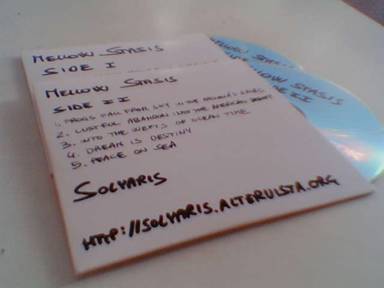
containing CD-Rs by composer-recordist Giorgio Robino, who releases his work under the name Solyaris (a tribute to great visionary film maker Andrei Tarkovsky.)
I've been listening for a few days now to MELLOW STASIS (REDUCED EDITION) and CELLAR DOOR. On these recordings, Robino uses the ringing, crystalline tones of lap steel and standard guitars as the starting point for long, emotionally evocative electronically-processed compositions (in particular, Robino utilizes long echos, delays, and looping) that manifest a highly-developed sense of tonality and resonant spaciousness. The music of Solyaris is engaging and engulfing, with a slow-motion drift; its subtle underlying structure might suggest the majesty of massive wind-swept sands or the infinite shimmer of stars at night.
On the surface of these works one might at first detect an undeniable sonic debt to ambient pioneers like Robert Rich and Steve Roach. But to my ears, Robino's work sounds wilder; more free and open to surprise than that of his musical forebears. I've really enjoyed falling into these adventurous and panoramic fields of sound.
For more about Solyaris, check out Robino's website here:
http://solyaris.altervista.org/

Between Waters


Alternating with days of work on my song collection have been days of work on abstract sound- art pieces about the shores and waters of Lake Champlain. That project has a new name now, too: BETWEEN WATERS, from the translation of the Abenaki name for the lake, Bitawbagw-- and, though the project is far from finished, I've reached a new perception of exactly what my efforts have arrived it.
Days of what I've come to call audio painting and sound-smearing have produced sounds that reflect back to me my true intent in this project. Yes, I want to express the allure and beauty of this powerful place; but I'm also haunted by the history of war and violence, of storm and shipwreck, that hides beneath the lake's now-placid surface. And this music, rather than seeking a transcendence of those things, is my way of going deeper, beneath layers and layers of rock and water and time, to find some kind of truth and resonance; actually a sense of healing.
This was made abundantly clear to me last week, when, after days of work on dark, rumbling pieces, I set up my cheap-o Artisan lap steel guitar-- in classic C6th tuning, of all things--with a set of delays, and recorded, in one take, a bittersweet improvisation that felt like an arrival at understanding. I named the piece "Searching for Ferris Rock (September Fog)" in honor of a glim-hazed day last summer, when I first spotted the buoy that, along with a line of dark cormorants, marked that massive, sub-aqueous slab of maritime hazard.
So now, feeling this sense of arrival, I'll take a break from this project. Spring weather has, at least temporarily, arrived. The band --Rusty Romance-- is starting to get busy again, so I'll be playing out again, away from the insular world of my home studio.
But I have ideas and sketches for more pieces in the BETWEEN WATERS project ; I want to give them some time to flow and percolate. They will arrive on my shoreline eventually.

An Ending, A Beginning

For the past two weeks I've been so deeply involved in my recording projects that I've not stopped to post my notes on the process here. But now, on the cusp of April, I've reached a state of completion and arrival, so I'll step back for a bit and try to describe what I' ve been up to.
First of all, my Americana song project is finished. And it's been renamed HORIZON IS A SONG-- from a line in my song "Ridin' Ahead of the Storm."
I had a surge of activity during March. It started with recording a short voice and Dobro version of the old gospel tune "Farther Along." I wanted to capture the sense of a gospel radio broadcast coming from far away in distance, and maybe even time. So I EQd and treated the recording for an old radio sound. I also dipped into a stash of radio static and dial-turning sounds I recorded a while ago, and placed them in the mix. The result is a sort of aural bridge between songs and feelings on the record.
Next up, the same day, was a simple voice and guitar version of a song I wrote when I was in my twenties. "Passport Photo" is, again, a late-night/early morning song, this time from a sort of jazz-bossa perspective. (It's actually a tribute to Lester Young, who was my absolute musical hero for a long time, a long time ago.) I did it in two takes, sitting in a carpeted hallway for that soft, intimate, close-up, dead-room sound.
I added a second voice and sparse second guitar, with bleed from the monitors in the other--much harder-surfaced-- room adding a cool sense of space with a strange, tight reverb. A couple of quick mixes, a touch of EQ and compression and voila: A jazzbo hipster vignette from my distant past!!!
A few days later came the piece that made the record finished. I'd been fooling around for a couple of days with my daughter's mandolin when, one morning, a song formed. I set up mics and tracked it in 3 takes. I spent the rest of the day adding more vocals, bass, and steel, then made a few mixes.
Later, a comment from Robin about the lead vocal sounding odd inspired me to again pull out that magic Radio Shack dynamic mic. With the mic handheld, I triple-tracked the lead vocal part. Panned together, those voices made for an instant, subtle Simon and Garfunkel sheen. Cool!
Eight hours spent on less than two minutes of music. But the next day I realized that this song-- called "That Sound"-- captured the theme of the album. One line in particular: "And I wonder if she'll hear it in the darkness when they broadcast this song.." nailed the essence of what the whole project was reaching for.
So now, the last song written would be the first on the album.

After a week or so of tweaking, remixing-- and fades, edits, etc.-- I realized that the album was finished. It had gone from hope and desire to actual entity.
Next time out, I'll get back to THE LAKE EFFECT, which, by the way, seems to have acquired a new name too....

Thursday, March 16, 2006

The Lake Effect, Part 3: Thrust Fault


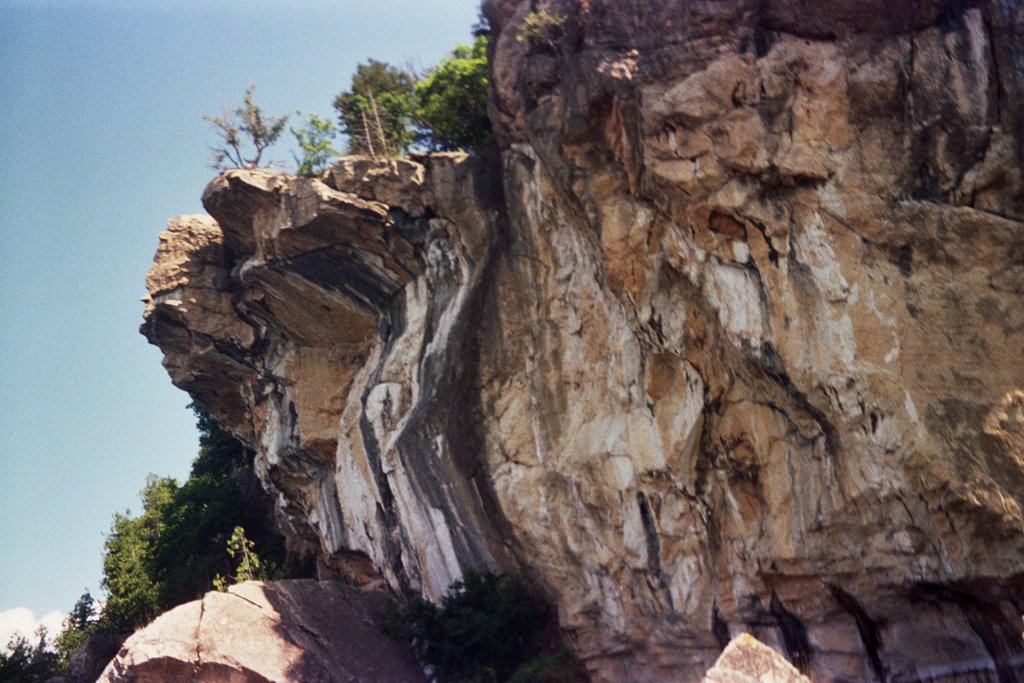
There is something about Lone Rock Point seen from the water that captures my imagination. Lone Rock Point, on Lake Champlain, is an example of what geologists call a thrust fault: a site where one can actually see an older stratum of rock that has, through the shifting of layers, ridden up above the newer, younger stratum. It's an ancient cataclysm frozen in time. Paddling close to this point in a kayak, I've been struck with awe-- even as I turned to look the other way across Burlington Bay to Shelburne point, where the Abenaki creator deity Odzihozo sits as a huge, silent rock on the water.
There's no doubt in my mind that this place is sacred. The Abenaki called Lake Champlain BITABAGW, which the great linguist of the Western Abenaki, Gordon M. Day, translated as : "between waters; alternating land and water."
That sense of threshold and layering between land and water is part of what calls to me to meditate on this place, to try and capture it in sound, in liminal music.
And then there's that dimension of ancient stone-- of frozen time; of history, memory, and topography in layers. Recently, I came across an entry in Thomas Merton's journals that caused in me a flash of recognition:

Time is valuable only for the moments that cut across and through it vertically...

This is exactly the energy that drives my passion to make art-- sound, words-- about the PLACES I find sacred.

So turning toward a piece to be called "Thrust Fault/Lone Rock Point", I begin with the music I've created to capture the energy and essence of crossing water. Now I slow it down, reharmonize it with the audio program ACID. I change EQ settings, treating timbre as both shape and color, as shadow and texture. Over the course of two day's work, I arrive at a piece with a slow rumbling energy, a dark sub-aqueous mystery.
But something is missing: something to cut through to a human scale of time-- something like Merton's moment.
A day later I find the missing sound. It's the harsh rattle of a kingfisher, that bird that strikes through surface tension to fish, then rises again into the air, with its goal, its quarry, held in beak. I treat and shape the recorded bird sound, layer it into the piece-- to represent the ancient eternal moment, frozen for our senses to apprehend and honor.